Multivariate Data#
A multivariate GP has a vector-valued output f(t), where f is now a vector of multiple dependent simultaneous output functions that share a common time correlated behavior (though perhaps with varying amplitudes). An example is a series of \(D\) parallel timeseries where each timeseries is taken at identical timestamps: \(\boldsymbol{f}(t) = (f_1(t), \dots, f_D(t))\).
There are two ways to handle such data in smolgp. One is to flatten the \(D\) timeseries into a single 1-D datastream and label each measurement with an index which is used to “select” the appropriate amplitude hyperparameter in the kernel’s observation_model, as is done in the tinygp tutorial here. Another is to simply input multidimensional noise (N, D, D) and y (N, D) arrays when defining and conditioning the GP object. Each of the \(N\) measurements will have a \(1 \times D\) vector of measurements and a \(D \times D\) covariance matrix.
Let’s build an example model for a pair of observed time series,
which will share a common underlying kernel (let’s pick the Matérn-5/2 kernel), but for fun let’s have \(y_1\) measure the value of the latent state (times an amplitude \(A\)) and \(y_2\) will measure its derivative (times another amplitude \(B\)). We can define this with the following observation matrix
which gives us the joint observation model for the output vector
where the measurement noise is drawn from \(\boldsymbol{\epsilon}_k \sim \mathcal{N}(0,\boldsymbol{R}_k)\) where
If our two measurements \(y_1\) and \(y_2\) are uncorrelated, then \(\boldsymbol{R}_k = \text{diag}(\sigma_{y_1}^2, \sigma_{y_2}^2)\).
import equinox as eqx
from tinygp.helpers import JAXArray
from smolgp.kernels import Wrapper

class FFprime(Wrapper):
    """
    A GP for a 2-D output where the observable is
    the state and its derivative, independently
    """

    scale: JAXArray | float
    sigma: JAXArray | float = eqx.field(default_factory=lambda: jnp.ones(()))
    amp1 : JAXArray | float = eqx.field(default_factory=lambda: jnp.ones(()))
    amp2 : JAXArray | float = eqx.field(default_factory=lambda: jnp.ones(()))

    def __init__(self, scale: JAXArray | float,
             sigma: JAXArray | float = 1.0,
             amp1: JAXArray | float = 1.0,
             amp2: JAXArray | float = 1.0,
             name: str='FFprime'):
        self.scale = scale
        self.sigma = sigma
        self.amp1 = amp1
        self.amp2 = amp2
        self.name = name
        self.kernel = smolgp.kernels.Matern52(scale=scale, sigma=sigma)

    def observation_matrix(self, X: JAXArray) -> JAXArray:
        """
        The observation model H for the observed state,
        with amplitude amp1 and the observed derivative,
        with amplitude amp2.
        """
        del X
        H = jnp.array([[self.amp1, 0, 0],
                       [0, self.amp2, 0]])
        return H
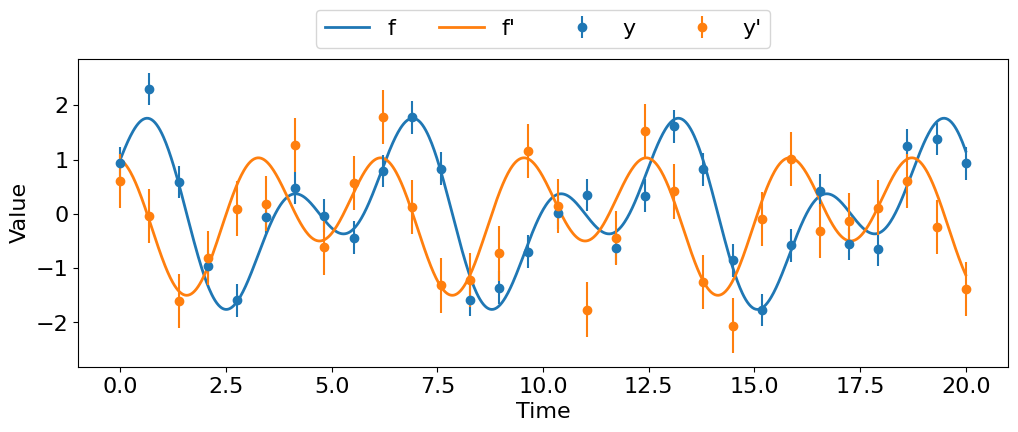
First, let’s define the true signal and simulate some data
# Ground truth functions for the state and its derivative
def f(t):
    return jnp.cos(t) + jnp.sin(2 * t)

def fp(t):
    # We'll also scale this down by a factor of 0.5
    return 0.5*(-jnp.sin(t) + 2 * jnp.cos(2 * t))

# Observation times and measurement noise
t = jnp.linspace(0, 20, 30) # observation times
sigma_y  = 0.3 # measurement noise for observations of y
sigma_yp = 0.5 # measurement noise for observations of the derivative of y
R = jnp.array([[sigma_y**2, 0], # assume no covariance for simplicity
               [0, sigma_yp**2]])
R = jnp.tile(R, (len(t), 1, 1)) # repeat for each observation time

# Simulate noisy observations of the state and its derivative
yerr_train = jax.random.multivariate_normal(key, mean=jnp.zeros(2), cov=R, shape=(len(t),))
y_train = jnp.stack([f(t), fp(t)], axis=-1) + yerr_train
# Plot the data and the true function
ts = jnp.linspace(0, 20, 1000)
fig, ax = plt.subplots(1,1, figsize=(12,4))
ax.plot(ts, f(ts), '-',  color='C0', lw=2, label='f')
ax.plot(ts, fp(ts), '-', color='C1', lw=2, label='f\'')
ax.errorbar(t, y_train[:, 0], yerr=sigma_y,  color='C0', fmt='o', label='y')
ax.errorbar(t, y_train[:, 1], yerr=sigma_yp, color='C1', fmt='o', label='y\'')
ax.set(xlabel='Time', ylabel='Value')
ax.legend(ncol=4, loc='lower center', bbox_to_anchor=(0.5, 1));
Now we can define the kernel and GP, and condition on the data
kernel = FFprime(scale=jnp.pi, sigma=1.0, amp1=3.0, amp2=1.5)
gp = smolgp.GaussianProcess(kernel=kernel, X=t, noise=R)
llh, condGP = gp.condition(y_train)
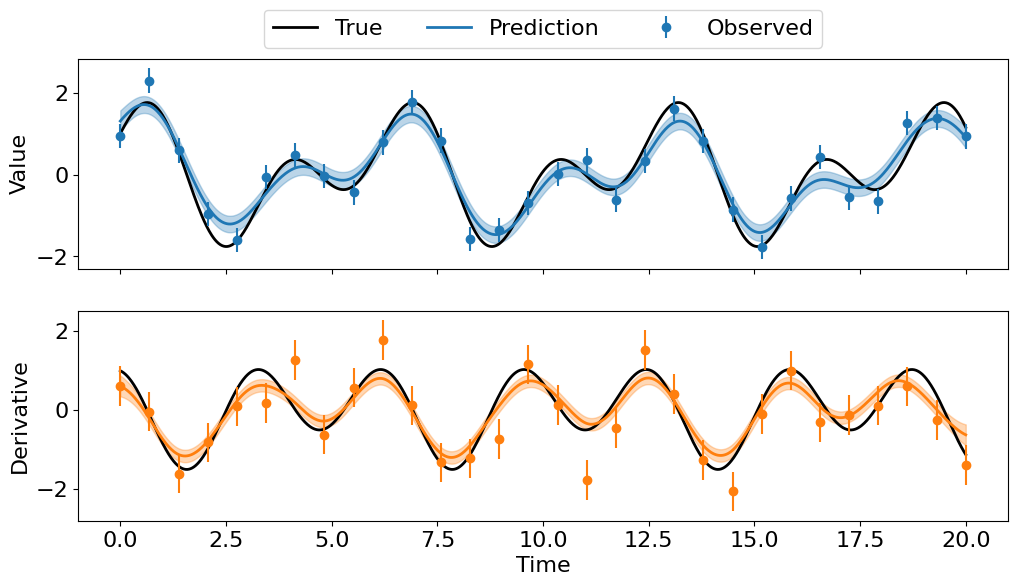
and plot the prediction
ypred, yvarpred = condGP.predict(ts, return_var=True)
yerrpred = jnp.sqrt(jnp.array([yvarpred[:, 0, 0], yvarpred[:, 1, 1]]))
fig, axes = plt.subplots(2, 1, figsize=(12,6), sharex=True)
axes[0].plot(ts, f(ts), '-',  color='k', lw=2, label='True')
axes[0].errorbar(t, y_train[:, 0], yerr=sigma_y,  color='C0', fmt='o', label='Observed')
axes[0].plot(ts, ypred[:, 0], '-', color='C0', lw=2, label='Prediction')
axes[0].fill_between(ts, ypred[:, 0] - yerrpred[0], ypred[:, 0] + yerrpred[0], color='C0', alpha=0.3)

axes[1].plot(ts, fp(ts), '-', color='k', lw=2, label='True')
axes[1].errorbar(t, y_train[:, 1], yerr=sigma_yp, color='C1', fmt='o', label='Observed')
axes[1].plot(ts, ypred[:, 1], '-', color='C1', lw=2, label='Prediction')
axes[1].fill_between(ts, ypred[:, 1] - yerrpred[1], ypred[:, 1] + yerrpred[1], color='C1', alpha=0.3)
axes[0].set(ylabel='Value')
axes[1].set(xlabel='Time', ylabel='Derivative')
axes[0].legend(ncol=4, loc='lower center', bbox_to_anchor=(0.5, 1));